
Stories
Old on Purpose: How the 70 Series Keeps Dodging Extinction
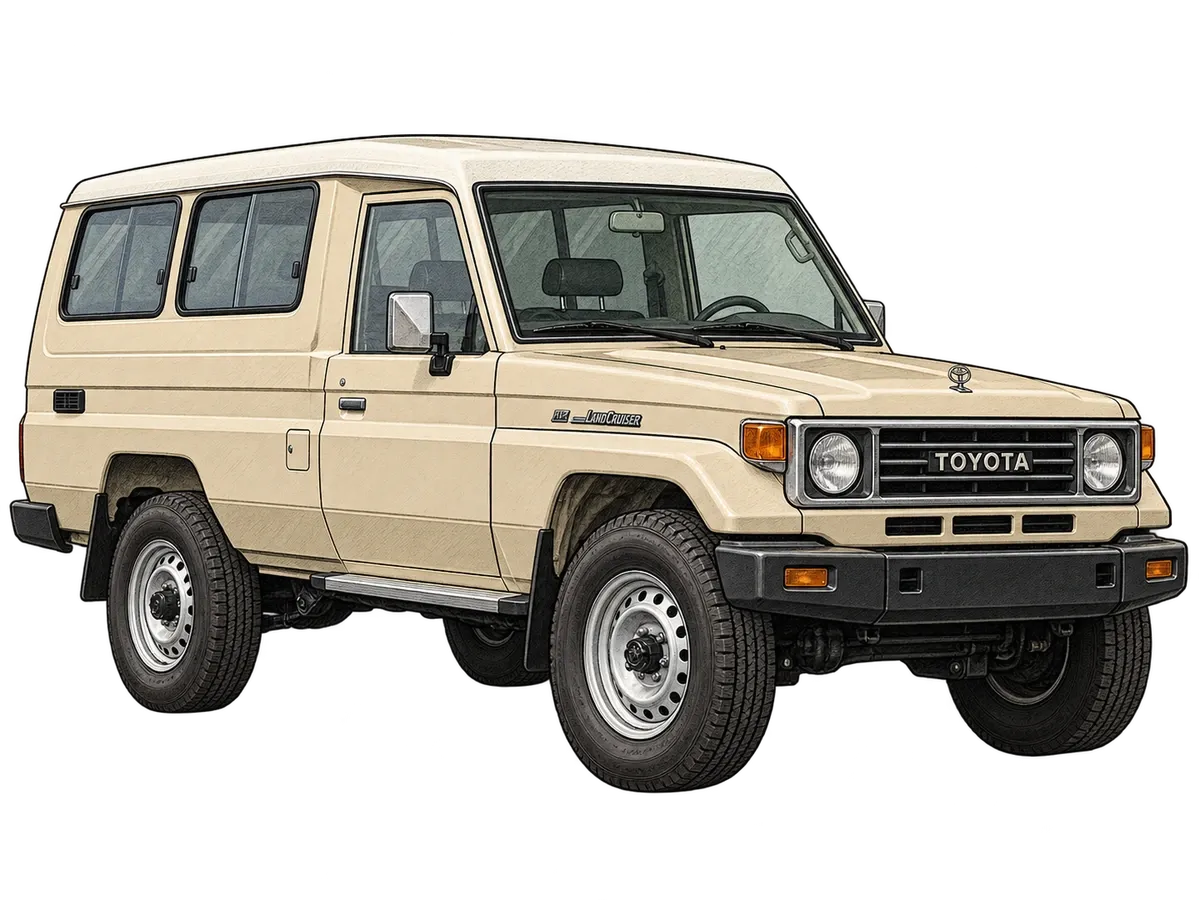
In November 2023, Toyota put a brand new Land Cruiser 70 back on sale in Japan.
That would have been unremarkable if the vehicle in question had not first appeared in 1984.
Nearly forty years after launch, Toyota brought the 70 Series home with a new diesel engine, an automatic gearbox, updated safety equipment and a more civilised interior.
But underneath it all was still a ladder frame, solid axles and part-time four-wheel drive.
Most cars survive four decades by becoming classics.
The 70 Series survived by staying in production.
A commercial vehicle that grew a cult
The 70 Series arrived in 1984 as the replacement for the 40 Series, the vehicle that had carried Toyota’s utility reputation through Africa, Australia and the Middle East for decades.
The brief was straightforward: keep the toughness, but make the vehicle more usable.
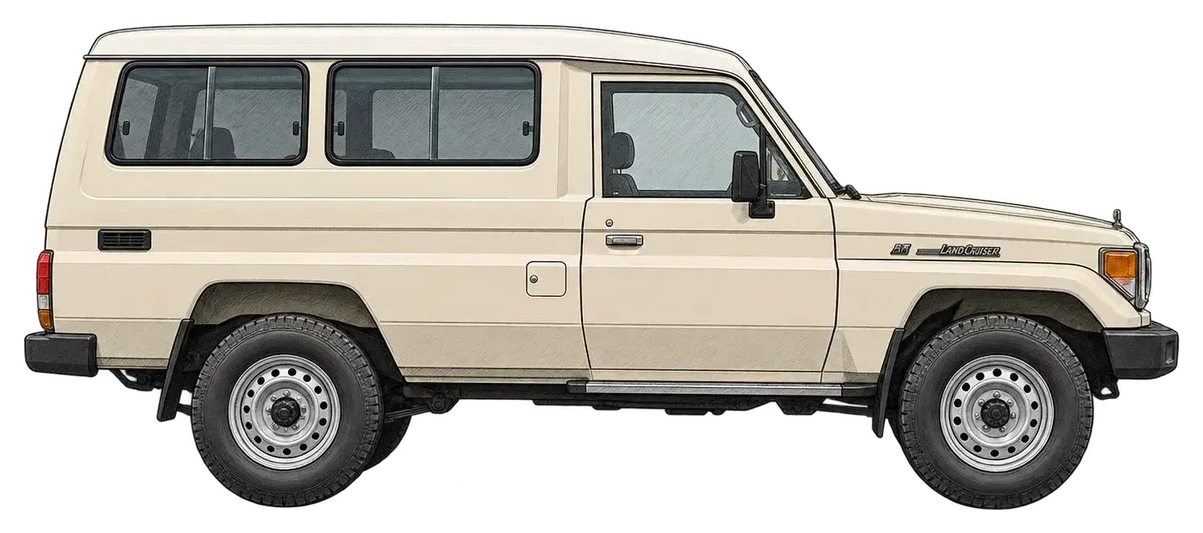
Depending on market and specification, the 70 family became everything from short-wheelbase utility trucks to long-wheelbase Troop Carriers, station wagons and cab-chassis pickups.
Underneath, the formula remained deliberately conventional.
Separate ladder chassis.
Solid axles.
Simple four-wheel drive.
Engines chosen at least as much for durability as refinement.
The naturally aspirated 4.2-litre 1HZ diesel became particularly associated with that philosophy. It was never sophisticated by modern standards, but sophistication was not really the point.
What mattered was that a mechanic in a remote workshop had a fighting chance of understanding what was in front of him.
That matters when the nearest dealer might be hundreds of miles away.
Everyone else moved on
The interesting thing about the 70 Series is not simply that it is old.
Plenty of long-running 4x4 names survived.
The difference is what happened to them.
Land Rover eventually replaced the original Defender with a modern unibody SUV.
Mercedes kept the G-Class’s ladder frame, but pushed much of the range deep into luxury territory.
The Nissan Patrol became larger, more powerful and considerably more sophisticated.
Toyota itself moved its wagon Land Cruisers through the 80, 100, 200 and now 300 Series.
The 70 took a different path.
It changed, certainly.
But it never really changed jobs.
The art of changing just enough
Standing still completely would have killed it.
Emissions standards tightened.
Safety expectations changed.
Fleet requirements moved on.
So Toyota kept modifying the 70 Series without rewriting the basic formula.
Australia is a good example.
By the middle of the 2010s, emissions and safety requirements meant the old vehicle needed substantial work simply to remain viable. Toyota added electronic stability control, revised the engine and structure and upgraded safety equipment.
Later came autonomous emergency braking and other driver-assistance technology.
The vehicle gradually accumulated electronics its early designers could never have imagined.
Yet underneath, the mechanical architecture remained recognisable.
That pattern continued when Japan received the 70 again in 2023.
The returning Japanese model gained Toyota’s 2.8-litre 1GD-FTV turbo-diesel producing 150kW and 500Nm, paired with a six-speed automatic transmission.
Toyota also improved on-road behaviour, safety equipment and the cabin.
But it retained the ladder frame and part-time four-wheel-drive system.
Toyota described expected Japanese sales as a base volume of 400 vehicles per month.
For something approaching its 40th birthday, there was clearly still a market for it.
Safety caught up with the old truck too
The tension between old-school architecture and modern regulation has not disappeared.
It has simply become part of the 70 Series story.
In 2025, ANCAP assessed current single- and double-cab 70 Series variants under its Large Utility grading system.
The result was Silver, with an overall score of 55%.
ANCAP found the vehicle’s autonomous emergency braking performed reasonably well, but the result was limited by gaps in its wider safety equipment. It had lane-departure warning, but no active lane keeping or blind-spot monitoring; seatbelt reminders covered the driver only.
That result probably describes the modern 70 Series better than any brochure can.
Where Toyota has fitted modern systems, many work perfectly well.
But nobody would mistake the vehicle for a clean-sheet 2020s design.
It is an old architecture being carefully persuaded to keep operating in a new world.
Built for places, not nostalgia
It is easy for enthusiasts to romanticise the 70 Series.
Toyota cannot afford to.
The vehicle still earns its living.
Mine sites, farms, remote operators, aid organisations and commercial fleets have used 70 Series Land Cruisers because they need something that can work hard, carry weight and operate a long way from sophisticated support.
That is why simplicity still matters.
Not because carburettors and manual window winders are somehow morally superior to electronics.
Because repairability, durability and familiarity have genuine value when a vehicle is being used as equipment rather than lifestyle decoration.
Owners in those environments are not asking Toyota to preserve history.
They are asking for the truck to start tomorrow morning.
Forty years of controlled evolution
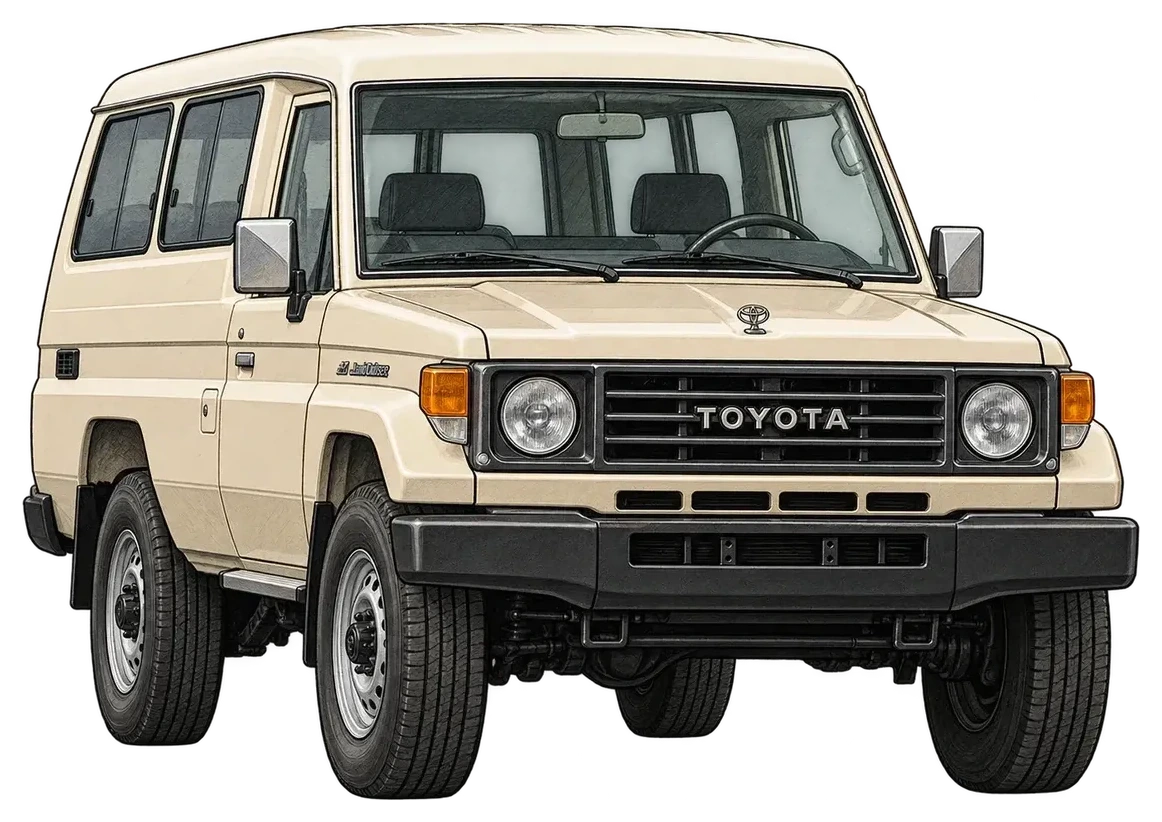
The 70 Series has changed more than nostalgia sometimes allows.
Engines have come and gone.
Electronics have arrived.
Safety equipment has improved.
Automatic transmissions have appeared in markets where a 70 once seemed inseparable from a manual gearbox.
The current vehicle is not a 1984 Land Cruiser wearing new lights.
But neither has Toyota used each new regulation as an excuse to reinvent it.
That is what makes the 70 unusual.
It has spent more than forty years evolving without surrendering its original job.
Most old vehicles eventually become collectibles.
The 70 Series somehow became both a classic and something you can still order to go to work.
Perhaps that is why nobody has managed to retire it yet.
Sources
- Toyota Global Newsroom — Toyota Re-introduces the Land Cruiser “70” in Japan (2023)
- Toyota Global — Land Cruiser Heavy Duty evolution
- Toyota Australia — LandCruiser 70 Series 2016 upgrade correction
- Toyota Australia — LandCruiser 70 Series gains autonomous emergency braking (2022)
- ANCAP — Toyota Landcruiser 70 Series Safety Grading (2025)